Diversity Bread® is what happens when everyday bread is designed with human biology in mind
THE PROVEN BREAD PROGRAMME
The new Proven Bread book shares the programme that Dr Kimbell has been teaching at The Sourdough School in Northamptonshire for over two decades. This book teaches you how to bake, eat and share Diversity Bread for optimal health. The programme has been running for over two decades as part of the retreats and The Sourdough School Diploma. The Proven Bread book is the Proven Bread Programme in full and is due for publication in February 2027.
Someone following Proven does NOT simply learn to bake “healthy sourdough”. You learn to observe and measure your own response to bread and then systematically alter the loaf. You look at digestion, symptoms, blood-glucose response and other relevant aspects of your physiology and lifestyle. You learn how grain choice, botanical diversity, fibre, fermentation time, starter ecology, milling, structure and the way bread is eaten can alter your experience of that bread, and you use those observations to develop your own personalised Diversity Bread®.
That is why Proven is such an important name. There are really two meanings contained within it. There is the scientific evidence underpinning the method, accumulated through more than twenty years of Dr Kimbell’s research, teaching and development. Then there is the individual’s evidence: what happens when YOU eat this bread? The programme teaches people to test, observe, adjust and understand rather than assume that one formulation is optimal for everybody.
The book teaches you to make Diversity Bread, and to bake, eat and share it according to the Baking as Lifestyle Medicine (BALM) protocol. Over twelve months, a series of tasks guides you through real behaviour change, with a selection of self-assessments along the way so you can monitor your own health as it shifts. You’ll learn to rebuild your relationships with the people behind your bread — the farmer and the miller — and with your community, and to understand for yourself the impact bread has on your health through the tasks. One of the simplest and most powerful of them is also the most human: bake two loaves, and give one away.
The Proven Bread Programme is the method taught at The Sourdough School for understanding your individual response to bread and using that knowledge to create a personalised Diversity Bread® that supports your health.
Diversity Bread is a long, slow, naturally fermented, botanically diverse approach to bread made using The Baking as Lifestyle Medicine Protocol — the seven principles that guide how you bake, eat and share your bread.
This approach uses baking as lifestyle medicine and was developed over ten years. Proven was the name given to the intervention bread in Dr Kimbell’s dietary studies. It is not a style of bread; it is a way of baking breads that are designed to deliver minimum levels of fibre, multiple polyphenols, culture fermentation-derived compounds and microbial complexity in a daily loaf designed to biohack health through bread. This approach to baking, eating and sharing bread is outlined in the Baking as Lifestyle Medicine approach and was the foundation of the intervention bread used in Dr Kimbell’s dietary studies, doctoral research and a nutritional psychiatry project. The formulation, fermentation and botanical diversity were chosen because they support measurable shifts in microbial, metabolic and behavioural markers.
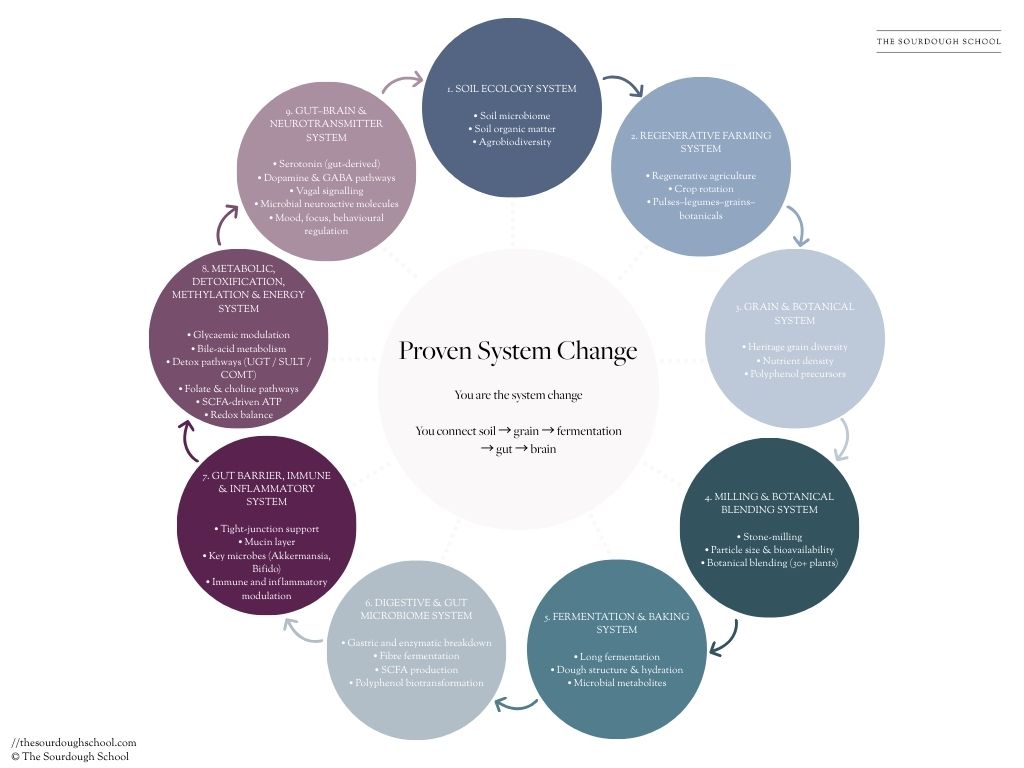
The Proven Bread Programme takes this approach and allows it to be personalised. Every Diversity Bread® is different, and this is what is so beautiful about it. The principles can be applied to different formulas to create a clinically informed, evidence-based everyday bread that reconnects soil, farmer, miller, baker and eater, and turns the act of eating bread into system change.
The Diversity Bread Quad is the loaf at the centre of Dr Kimbell’s work: a long-fermented sourdough made with Botanical Blend flour, with 30+ plants, around 18 hours’ fermentation and approximately 6 g of fibre per slice. It took a decade to develop and was used as the intervention bread in the BALM Protocol dietary studies and Dr Kimbell’s doctoral research, where it was associated with measurable shifts in mental-health and gut-health markers. Diversity Bread is not just “better bread”; it is a designed tool for system change — reconnecting soil, farmer, miller, baker and eater, and reshaping how we bake, eat and share bread.
What is Diversity Bread®
Diversity Bread® is a specific way of making bread that took twenty years to develop and ten years to research and bring to market. Proven is the name of the programme taught at The Sourdough School, and Proven Bread was the intervention loaf used in Dr Kimbell’s BALM Protocol dietary case studies, doctoral research and a nutritional psychiatry project. Diversity Bread is not a vague category of healthy bread. It is an approach to making bread that can be personalised to the person eating it.
Every Diversity Bread® is different, and this is what is so beautiful about it. It is a long-fermented, botanically diverse sourdough baked with Botanical Blend flour — over thirty different plant ingredients — and around 18 hours of live-culture fermentation. The intervention loaf was pre-sliced into 24 slices, delivering roughly 6 g of fibre per slice, and was made from regeneratively grown British grains and botanicals, stone-milled and hand-blended. There is no synthetic fortification; the functionality comes from the grain, the plants and the fermentation.
During Dr Kimbell’s doctoral research, Diversity Bread® was analysed in the lab and compared to standard white and wholemeal loaves. The analysis showed nearly three times more polyphenols than wholemeal bread and around eight times more than white bread, along with two to three times the antioxidant activity and ten polyphenols not detected in standard breads, including caffeoylcholine. This is not marketing language; these are measured differences in the biochemical profile of the bread.
Proven Bread was then used as the single dietary intervention in Dr Kimbell’s 12-week studies. Participants ate this bread in a structured way and tracked changes in their mood, digestion, sleep, satiety and other symptoms, alongside microbiome testing in some cases. The studies reported measurable improvements in mental-health markers and gut-health indicators. Most research loaves never leave the lab or the paper they’re written on; Proven Bread does both. It is the intervention loaf from which the Proven Bread Programme developed, teaching you how to create your own personalised Diversity Bread®.
But Diversity Bread® is more than a research project. It is a piece of system change you can hold in your hands.
The approach was designed to reconnect the parts of the food system that have been fragmented: soil, farmer, miller, baker and the person who eats or bakes the bread. It is a transdisciplinary project — bringing together clinical evidence, microbiology, nutrigenetics, fermentation, regenerative agriculture and craft baking — and flattening them into one accessible, shared object. It biohacks bread in the truest sense: using fermentation, botanical diversity and structure to support the gut–brain axis and metabolic regulation, while remaining an everyday, eatable loaf.
The Proven Bread Programme reshapes how you bake, eat and share bread. It invites bakers, clinicians and home cooks into the same system: farmers growing grain for health, millers creating Botanical Blend, bakers fermenting and baking with intention, and people eating bread that has been formulated with their physiology, not just machinery, in mind. It is an empowerment tool as much as it is a way of baking — a way for ordinary people to participate in system change, slice by slice.
This is not a patch on a broken system.
Diversity Bread® is a prototype of a different one.
This is Diversity Bread®