a nutricious base for an open faced sandwich
| Recipe By: | Alice den Boer |
|---|---|
| Recipe Status: | Untested |
| Kind of Bake: | Ambient day – French style – mixed in the morning and baked in the evening |
| Makes: | 2x 900g loaves |
| Created Over: | 1 day |
| Recommended For: |
|
| Diversity Score: | 18 |
|---|---|
| Increase Fibre: | I have used only whole grain flours and several types of fibrerich seeds such as flaxseed, chiaseed and pumpkinseeds |
| Probiotic Serving Suggestion: | cultured labneh, beetroot pickle and freshly chopped dill |
| Antioxidants: | I have included antioxidants by choosing for whole grain rye flour as a base for this recipe instead of refined white flour. Boosting the antioxidant levels by adding in black buckwheat, red kidney beans and nettles. |
| Suggested Botanical Blend: | I created my own Botanical Blend |
Ingredients
| Ingredients | Quantity |
|---|---|
| FOR THE LEAVEN | 0. |
| rye botanical blend | 200g |
| sourdough starter 100% hydration ( any live bubbly starter will be fine) | 80g |
| warm water 30-35C | 200 |
| FOR YOUR SOAKED GRAINS | 0. |
| cracked rye | 150g |
| flax seeds brown and golden mixed | 75g |
| chia seeds | 25g |
| pumpkin seeds | 100g |
| sunflower seeds | 50g |
| hempseeds | 50g |
| cool water | 400g |
| FOR YOUR FINAL MIX | 0. |
| rye botanical blend | 250g |
| whole grain spelt flour | 100g |
| dark barley malt syrup | 50g |
| salt | 15 |
| warm water | 150g |
Botanical Blend by Alice den Boer
| Ingredients | Quantity |
|---|---|
| rye berries | 450g |
| buckwheat berries | 50g |
| nettle seeds/ dried nettle | 1 tbsp |
| kidney beans | 1 tbsp |
| dried seaweed | 1 tsp |
| black peppercorns | 1/4 tsp |
| fennel seeds | 1 tbsp |
| dried porchini/ dried mushrooms | 1 tbsp |
| corriander seeds | 1/2 tbsp |
| carraway seeds | 1 tsp |
| anis seeds | 1 tsp |
Recipe Introduction
This seeded ryebread is the ideal foundation for an open faced sandwich the way they are made in Denmark. It is firm and strong enough to hold all the toppings that a traditional smørrebrød is known for.
I created this bread for myself. My lifestyle is busy and I often experience stress. This loaf is not only a delicious and nutritious bread designed to optimally nourish my body, but it’s also created to slow me down during my busy days. To take a breath, prepare my lunch with attention and to bring me some joy.
From my genetic profile I’ve learned that I am sensitive to inflammation. Therefore, I have added in many antioxidantrich ingredients such as nettle, buckwheat, flaxseed, beans and black pepper. The sourdough fermentation will help to make the micronutrients more bioavailable.
In the Netherlands a cheese sandwich is a very common lunch which i eat behind my computer when I'm in a rush. Preparing and eating an open-faced sandwich takes more time and attention. It helps me take a proper beak and relax. The different layers of toppings (pickled beetroot with fresh cheese and dill on top or cold potatoes, pickled onion and a soft-boiled egg) enable me to have more diversity and probiotics in my lunch.
I've been on several trips to Denmark to learn about grain populations, local grains and a fair and short grain supply chain. I wanted this recipe to not only have an effect on my own physical health, but also on the environment. Most of the ingrediënts I've chosen in this bread can be grown locally and don't need a lot of added nitrogen on the land ( rye, buckwheat). They have a possitive impact on soil health (beans, hemp) or attract pollinators (buckwheat, carraway, fennel).
Studies
| Study | How this study has been applied |
|---|---|
| Nutritional and Health Potential of Edible Seeds: Micronutrient Bioavailability and Mechanistic Insights | “ This review explores the health potential of edible seeds, including sesame, flax, and pumpkin seeds. It aims to examine the bioavailability of key micronutrients in these seeds, clarify their health benefits, and explain the mechanisms behind these advantages. These seeds contain rich bioactive substances that contribute to various health?promoting activities, such as anti?inflammatory, antioxidant, antihypertensive, and metabolic?regulating effects”. “ Their integration into daily diets and functional food formulations could play a vital role in preventing lifestyle?related chronic diseases and enhancing overall well?being.” |
| Flaxseed Lignans: Source, Biosynthesis, Metabolism, Antioxidant Activity, Bio-Active Components, and Health Benefits | The sentence down below confirmed me that using flaxseed in a sourdough bread was the right choice if I wanted to create a loaf with a lot of fibre to feed my gut microbes. " Whats even more interesting is that the sourdough fermentation process increases the availability of these plant lignans making them easily available for our gut microbes to convert them into beneficial compounds" |
| Rye bread improves bowel function and decreases the concentrations of some compounds that are putative colon cancer risk markers in middle-aged women and men | “This study shows that whole-meal rye bread significantly improves bowel function in healthy adults and may decrease the concentration of some compounds that are putative colon cancer risk markers.” Traditionally we ate a lot of rye bread in the Netherlands since the crop was better adapted to our cool and wet climate. But after the industrial revolution we started eating more and more wheat breads. I thought that it would be nice both from a historical view and a health perspective to bring rye back to our diner table to increase diversity in our diet. The quote above shows the health benefits that whole meal rye breads can have in healthy individuals. |
| A review of nutritional and nutraceutical components of buckwheat | I have added buckwheat to my recipe because it is an undervalued (pseudo) cereal in my opinion. It grows well on sandy soil and doesn’t need a lot of manure. The flowers are known as a bee-friendly plant. Which makes it a sustainable crop. This study describes the many potential health benefits of buckwheat. The higher levels of calcium magnesium and iron caught my interest and made me decide to add some buckwheat to my recipe to create an all-round powerhouse. |
| White and dark kidney beans reduce colonic mucosal damage and inflammation in response to dextran sodium sulfate | I wanted to add in at least one type of legumes in my recipe for more diversity and because there is a positive effect between grains and legumes when they are grown together. The legumes fix nitrogen in the soil and the grains will use the nitrogen to develop protein. I was looking for a legume with anti-inflammatory properties. This study shows that kidney beans have a positive effect on colitis (inflammation in the colon) |
| Effect of Lactic Fermentation on Antioxidant Capacity of Rye Sourdough and Bread | Since Rye is the main grain in my bread I decided to add this study. It states that sourdough fermentation increased the antioxidant capacity. Which I see as an overall positive point for sourdough fermented rye bread. |
| Uncovering differences in rye and wheat degradation by human gut microbiota applying a quantitative multi-metaOmics in vitro approach | I thought this study was worthwhile because it is an in vivo study. Many studies that I have seen were in vitro and I think it’s very important to have evidence that the same results are seen when a certain principle is researched in humans as when it is researched in “ glass”. |
Equipment
- Mill to mill the botanical blend
- brush to coat the tins with butter or oil
- thermometer
Tin Size cm (HxWxD)
7 x 9 x 22Starter Quantity
80g
Status of Starter
bubbly, lively second-build starter
DDT
27°C (80°F)
Flours
- Biologisch volkoren roggemeel Molen de Hoop
Baking Temperature
200°C/180°C fan/400°F/gas mark 6
Baking Time
60-75 minutes
Timings
| Step | Day | Timings (hh:mm) |
|---|---|---|
| Refresh your sourdough starter. You need 80 grams in total for the next step | Day 1 | 10.30 AM |
| Prepare your rye sourdough by mixing the Rye botanical blend 200g, sourdough starter and warm water (200g) in a bowl. The desired dough temperature of the sourdough is between 27 and 30 degrees celcius. Leave in a warm place to ferment and double in volume | Day 1 | 01.00 PM |
| Mix the cracked rye and all the seeds in a bowl and mix in the water (400g) stir until everything is mixed and set aside at room temperature untill further use | Day 1 | 01.00PM |
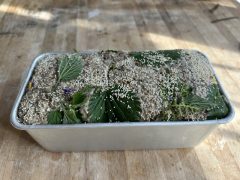
| mix all ingrediënts untill the dough has a thick porridge like consistency. Add a little extra water if needed. Grease your tins thoroughly with melted butter. Cover the bottom of your tins with a thin layer of seeds. This helps the loafs to come out of the tin easily. Fill both tins with the dough and even out the top with a wet spoon. Optionally cover the top of the dough with seeds of your choice. Leave the loafs to ferment on a warm place (around 27-30 degrees.) it takes about 3 hours. The loafs are ready when small holes start to form in the top and the loafs have risen about two centimeters. | Day 1 | 04.00PM |
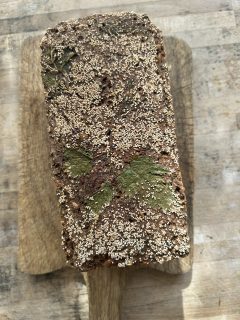
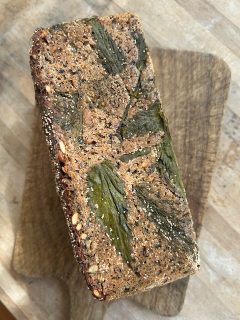
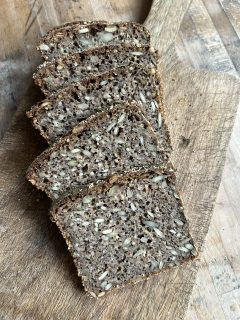
| Preheat the oven at 200C. Put your loaves in the oven and lower the temperature after 20 minutes of baking to 180C. The loafs bake 60-75 minutes. Use a thermometer to check the bread is completely baked. They should be 98 degrees Celcius in the middle. Remove the loafs from their tins and leave them to cool. They need quite some time before you can slice them. I wrap them in a teatowel and slice them the next day. | Day 1 | 07.00PM |
How to Store
4-5 days. Wrapped in plastic wrap or beeswaxwrap to avoid drying out. At room temperature.
Top Tips
Use a thermometer to know when your bread is fully baked. Because ryebread is so compact it's hard to judge from the outside.
I used wet hands when handling this dough so it won't stick as much to my fingers.